

Media / Blog
The critical role of Retailers in the Bullwhip effect on Manufacturing.

The critical role of Retailers in the Bullwhip effect on Manufacturing.
ndw-i | Sustainable Business Optimisation
Introduction
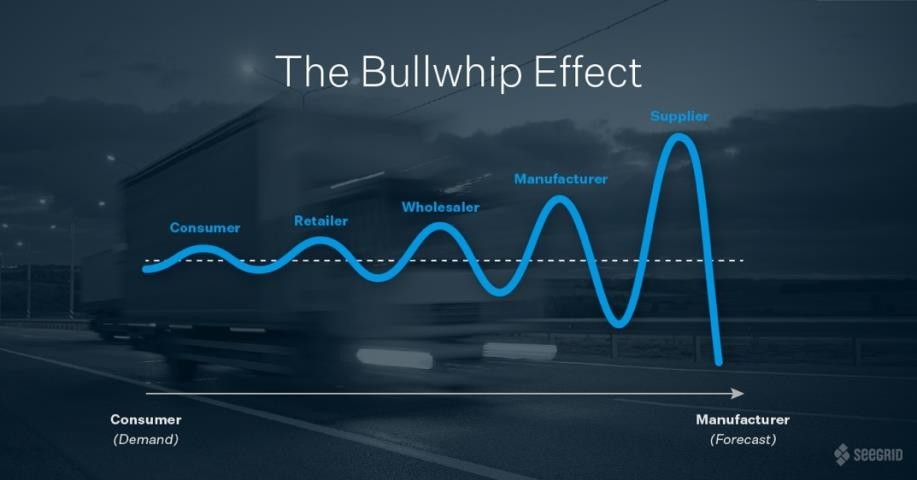
Retail plays a crucial role in the global economy, acting as the final bridge between manufacturers and consumers. However, what happens at the retail level doesn’t just stay there it ripples upstream, significantly impacting suppliers, distributors, and manufacturers. One of the most well-documented phenomena in supply chain management is the bullwhip effect, where small fluctuations in retail demand leads to amplified distortions in inventory levels upstream and production.
Understanding the bullwhip effect is essential for businesses looking to maintain efficiency, control costs, and improve overall supply chain resilience. This post explores how retail drives this effect, provides real-world examples, includes relevant quantitative data, and discusses strategies for mitigating its impact.
How Retail Triggers the Bullwhip Effect
Retailers act as demand aggregators, collecting and responding to consumer purchasing trends. However, even slight shifts in consumer behaviour can have drastic effects when they travel upstream. Here’s how the cycle unfolds:
- Consumer Demand Variability – Seasonal trends, promotions, and economic conditions cause fluctuations in sales.
- Retailer Reaction – Retailers adjust their orders to maintain optimal stock levels, sometimes overcompensating based on perceived trends.
- Supplier Adjustments – Wholesalers and distributors react to retailer orders, often inflating their own orders to prepare for future uncertainties.
- Manufacturer Response – Manufacturers, seeing increased demand, ramp up production, often leading to excessive inventory buildup.
- Overcorrection and Waste – As actual demand stabilizes or decreases, excessive inventory leads to overstocking, markdowns, and supply chain inefficiencies.
This chain reaction creates volatility, with each upstream player reacting to demand signals that may not reflect actual end-consumer needs.
Real-World Examples and Data on the Bullwhip Effect
1. COVID-19 and the Retail Supply Chain
At the onset of the pandemic, retailers saw a 40% surge in demand for essentials like toilet paper and cleaning supplies. In response, they placed massive orders, prompting manufacturers to ramp up production. However, once panic-buying subsided, retailers were left with excess inventory levels reaching 30% above pre-pandemic norms, while manufacturers struggled to scale down production efficiently.
2. Tech and Electronics Industry
Gaming consoles and GPUs frequently experience demand spikes during product launches or holiday seasons. In 2020, due to supply shortages, retailers increased orders by over 50%, leading suppliers to overproduce. By mid-2022, inventory levels at major retailers such as Best Buy and Amazon were 25% higher than demand, causing forced markdowns and profit losses.
3. Fashion and Apparel Retail
Fast fashion retailers often respond to trends by ordering more inventory than needed. In 2021, U.S. fashion retailers experienced inventory surpluses of nearly 15% due to inaccurate forecasting. The bullwhip effect led to markdowns exceeding $300 billion globally, significantly impacting profit margins.
How Businesses Can Mitigate the Bullwhip Effect
1. Improved Demand Forecasting
Leveraging AI-driven analytics and real-time data tracking can help retailers and manufacturers make more accurate demand predictions, reducing unnecessary stock fluctuations. Advanced machine learning models have improved forecasting accuracy by 20–30% in many industries.
2. Enhanced Supply Chain Communication
Transparency between retailers, suppliers, and manufacturers ensures that information about real consumer demand flows smoothly across the chain, minimizing overreactions. Retailers that implement collaborative planning, forecasting, and replenishment (CPFR) systems have seen supply chain inefficiencies decrease by up to 15%.
3. Just-in-Time (JIT) Inventory Management
Adopting JIT principles reduces excess stock and ensures production aligns more closely with actual market needs, lowering waste and improving efficiency. Toyota, a leader in JIT, has reduced excess inventory holding costs by 50% through this methodology.
4. Agility at the Retail Level
Retailers that adopt agile inventory management practices can optimize stock levels dynamically based on real-time demand insights. Agile retail operations integrate automated replenishment systems, predictive analytics, and flexible warehousing, allowing businesses to respond quickly to market changes. Companies using agile retail strategies have seen inventory turnover rates improve by up to 35% while reducing excess stock by 20%.
Agility enables retailers to mitigate supply chain shocks by shifting sourcing strategies, diversifying suppliers, and using localized fulfilment centres. By reducing lead times and preventing overstock situations, agile retailing plays a crucial role in preventing disruptions from cascading upstream to manufacturers.
5. Flexible Manufacturing and Distribution Strategies
Investing in agile production methods allows manufacturers to scale up or down quickly in response to changing demand. Similarly, multi-tiered distribution networks can help buffer against sudden supply shocks. Companies that adopt flexible supply chain strategies experience a 30% reduction in operational disruptions compared to those using rigid systems.
6. Retailer-Supplier Collaboration
Retailers and manufacturers can work together using vendor-managed inventory (VMI) systems, where suppliers take on a more active role in managing retail stock levels. This reduces uncertainty and enhances supply chain efficiency. Studies show that VMI implementation can cut inventory costs by 25% while improving stock availability by 20%.
Conclusion
Retail is the heartbeat of the supply chain, but its influence extends far beyond store shelves. The bullwhip effect highlights how small shifts in consumer demand can have exponential consequences for manufacturers. However, by leveraging data, improving communication, and adopting flexible inventory strategies, businesses can minimize disruptions and create a more resilient supply chain.
Retailers that embrace agility and data-driven inventory management can significantly optimize stock levels, reduce waste, and enhance supply chain efficiency. This approach not only benefits retailers but also stabilizes upstream operations for suppliers and manufacturers.
Understanding and mitigating the bullwhip effect isn’t just a manufacturer’s responsibility—it’s a collective effort involving retailers, distributors, and suppliers alike. By working together, businesses can ensure smoother operations, lower costs, and enhanced customer satisfaction.